Introduction
In an era where governments are under increasing pressure to deliver efficiency, transparency, and accountability, digital transformation is no longer optional — it’s imperative. Civic bodies and urban development departments are especially burdened with managing massive volumes of projects, vendors, and public funds. Yet many still rely on manual processes, spreadsheets, and disconnected legacy systems.
The result? Delays in project execution, opaque fund utilization, and an administrative workload that hinders rather than helps governance.
This is the story of how a state-level urban development authority adopted Presear ERP – Governance Edition, a Python-based, AI-driven enterprise platform by Presear Softwares, to completely overhaul its internal systems.
Within a year, the department digitized its budgeting, procurement, and project monitoring workflows, achieving 100% traceability of funds, 87% faster approvals, and real-time public transparency dashboards for citizen engagement.
This wasn’t merely software deployment — it was a systemic reinvention of governance using data intelligence, automation, and accountability at every level.
Background: The Governance Challenge
The department oversaw infrastructure and civic projects across multiple districts — roads, housing, water supply, waste management, and public amenities. With over 2,000 active projects, 500 vendors, and ₹2,500 crore allocated annually, the volume of operations had long surpassed the capacity of manual systems.
Each division maintained its own data formats. Project reports were submitted manually. Tender evaluations took weeks, and expenditure records were reconciled only at the end of each quarter.
The consequences were significant:
Budget inefficiency: Funds often sat idle in one project while another ran short.
Procurement delays: Tender processing and vendor selection required months.
Data opacity: The leadership team had limited real-time visibility into fund flow and project progress.
Compliance risks: Audit trails and document traceability were inconsistent.
To solve these challenges, the administration sought a single, intelligent ERP platform capable of real-time monitoring, automation, and predictive governance analytics.
The Vision: A Digital Nerve Center for Civic Administration
The department envisioned an ERP system that could:
Digitize all financial and administrative processes,
Automate procurement and tendering,
Ensure accountability through complete audit trails,
Monitor project progress and milestones in real-time, and
Provide citizen-facing transparency dashboards.
When Presear Softwares was brought in, the brief was clear:
“We need a system that unifies governance data, enforces compliance, and helps us make faster, evidence-based decisions.”
Presear proposed a tailor-made solution — Presear ERP – Governance Edition, built around four core principles:
Unified Data Architecture
AI-Augmented Decision Intelligence
Automation and Traceability
Transparency and Public Trust
Built entirely in Python, and powered by Presear’s in-house AI models, this ERP would redefine how the department planned, executed, and communicated every project.
Phase 1: Diagnostic and Process Mapping
Before writing a single line of code, Presear’s digital transformation consultants conducted a full Governance Process Assessment.
Over six weeks, they analyzed workflows across:
Key Findings
| Problem Area | Issue Identified | Impact |
| Budgeting | Funds allocated manually, inconsistent reporting formats | Slow approvals, data mismatches |
| Procurement | Paper-based tenders, manual vendor evaluation | Delayed project initiation |
| Project Monitoring | Fragmented progress updates | Lack of milestone visibility |
| HR & Payroll | Legacy systems, no integration with project teams | Salary mismatches, delayed reimbursements |
| Public Transparency | No real-time citizen dashboard | Trust deficit and delayed communication |
These findings reinforced the need for a unified, AI-enabled ERP backbone capable of handling administrative complexity while remaining user-friendly for officers and staff.
Phase 2: System Architecture Design
Presear’s engineers designed a five-layer ERP architecture focused on modularity, security, and scalability.
| Layer | Functionality |
| Data Layer | Oracle/PostgreSQL hybrid storage for financial and operational data |
| Business Logic Layer | Python microservices handling budgeting, payroll, procurement, and project workflows |
| AI Intelligence Layer | Forecasting, anomaly detection, and NLP-based document parsing |
| Automation Layer | Event-based triggers for workflow approvals and fund releases |
| Interface Layer | Web and mobile dashboards for administrators, vendors, and citizens |
This architecture allowed the ERP to integrate seamlessly with existing government portals, including PFMS (Public Financial Management System), GeM (Government eMarketplace), and GIS-based Project Monitoring Tools.
Technology Stack
Programming: Python (FastAPI, Django)
AI Models: PyTorch, Scikit-learn, Hugging Face Transformers
Database: PostgreSQL + Redis cache
UI/UX: React with responsive design
Cloud Deployment: Hybrid on OCI and NIC private cloud
Security: OAuth 2.0, AES-256 encryption, PKI certificates
Phase 3: AI Enablement and Smart Governance Modules
The heart of Presear ERP’s transformation lies in its AI-driven governance layer, which uses in-house machine learning models to automate, predict, and audit key administrative processes.
1. Budget Forecasting and Allocation
Using time-series forecasting models built in Python, the ERP predicts expenditure and allocates budgets dynamically based on:
This allowed the finance department to reallocate funds proactively, avoiding underutilization and ensuring timely execution.
2. Intelligent Procurement Engine
A NLP-based document intelligence module automatically parsed tender documents, extracted compliance criteria, and cross-referenced them with vendor submissions.
An AI scoring model evaluated vendors using historical performance, delivery timelines, and financial reliability — ensuring objective, data-backed procurement decisions.
Procurement time reduced by 73%.
3. Project Progress Analytics
Using predictive modeling, the ERP analyzed project milestone data and satellite-linked progress updates (via GIS integration).
If a project deviated from schedule, the system flagged anomalies, predicting potential delays and recommending interventions.
This early warning system helped prevent 15 major project overruns within the first six months.
4. Anomaly and Fraud Detection
A custom autoencoder-based anomaly detection engine monitored financial transactions and expense claims.
Irregular patterns such as duplicate invoices or suspicious fund transfers were flagged automatically for review, reducing financial risk significantly.
5. HRMS and Payroll Automation
The HR module unified employee records, attendance, and payroll. AI-assisted reconciliation matched project-linked wages and resource allocations to ensure transparency and prevent fund misallocation.
6. Citizen Dashboard and Transparency Portal
Presear designed a public-facing portal where citizens could view project progress, fund allocation, and tender results in real-time.
All data was fetched through secure read-only APIs from the ERP database, ensuring public transparency without compromising security.
Phase 4: Implementation and Training
Implementation was phased over eight months, divided into functional rollouts:
Finance and Budgeting System — Replaced legacy spreadsheets with automated budget workflows.
Procurement and Vendor Portal — Introduced digital tendering and e-approvals.
Project Monitoring Dashboard — Integrated field data with live project analytics.
HR and Payroll System — Unified records for 3,000+ employees.
Citizen Transparency Portal — Launched publicly with bilingual interface.
Change Management and Training
200+ administrative staff trained through on-site workshops and digital learning modules.
Officers introduced to explainable AI dashboards, showing why the system suggested specific budget allocations or vendor scores.
A dedicated Presear support desk monitored adoption rates and provided iterative improvements.
This people-first approach ensured smooth transition and trust in automation.
Phase 5: Outcomes and Measurable Results
Within the first year of deployment, the department recorded major efficiency and transparency gains.
Operational Metrics
| Parameter | Before Presear ERP | After Presear ERP |
| Budget Reconciliation | 15–20 days | 3 days |
| Procurement Cycle Time | 45–60 days | 12–15 days |
| Project Progress Visibility | Limited, manual | Real-time (100%) |
| Audit Readiness | 40% | 100% with traceable trails |
| Payroll Processing | 7 days/month | 1 day |
| Citizen Grievance Resolution | 10–12 days | < 48 hours |
| ROI on Implementation | — | 4.1× in first 12 months |
Financial Efficiency
₹87 crore saved annually through reduced process delays and wastage.
15% improvement in fund utilization efficiency across fiscal quarters.
Audit compliance scores improved dramatically, reducing external audit dependency.
Technical Innovations That Made It Possible
1. Python-Powered Core
All Presear ERP modules were built in Python for flexibility, scalability, and integration with AI models.
Libraries like Pandas, NumPy, and Statsmodels handled financial analytics, while PyTorch and Scikit-learn powered the forecasting and anomaly detection models.
This allowed seamless bridging between traditional ERP logic and modern AI intelligence.
2. Machine Learning for Governance Analytics
Presear ERP’s AI suite incorporated:
LSTM models for fund forecasting,
Autoencoders for anomaly detection,
BERT-based NLP models for document classification, and
Reinforcement learning algorithms for procurement optimization.
All models were deployed through FastAPI endpoints, enabling real-time inference within ERP workflows.
3. MLOps and Continuous Learning
AI models were versioned and retrained automatically using MLflow pipelines, ensuring relevance as new financial and operational data arrived. This made the system self-improving — the longer it ran, the smarter it became.
4. Audit-Ready Transparency Layer
Every action — approvals, edits, uploads, fund transfers — was automatically logged in immutable audit trails. The blockchain-ready ledger option ensures that all actions remain traceable for compliance.
5. Citizen-Centric Design
The public portal was not an afterthought; it was integral to the system’s architecture. Citizens could track infrastructure projects by:
District,
Contractor,
Budget utilized, and
Completion percentage.
This built public confidence in how resources were being managed.
Human Impact: From Bureaucracy to Accountability
What changed most dramatically was the mindset of the workforce.
Officers who once spent days compiling paper reports could now visualize budgets, project progress, and fund flows instantly.
Procurement officers no longer feared audit deadlines — every tender, bid, and approval was automatically versioned, timestamped, and justified by AI scoring.
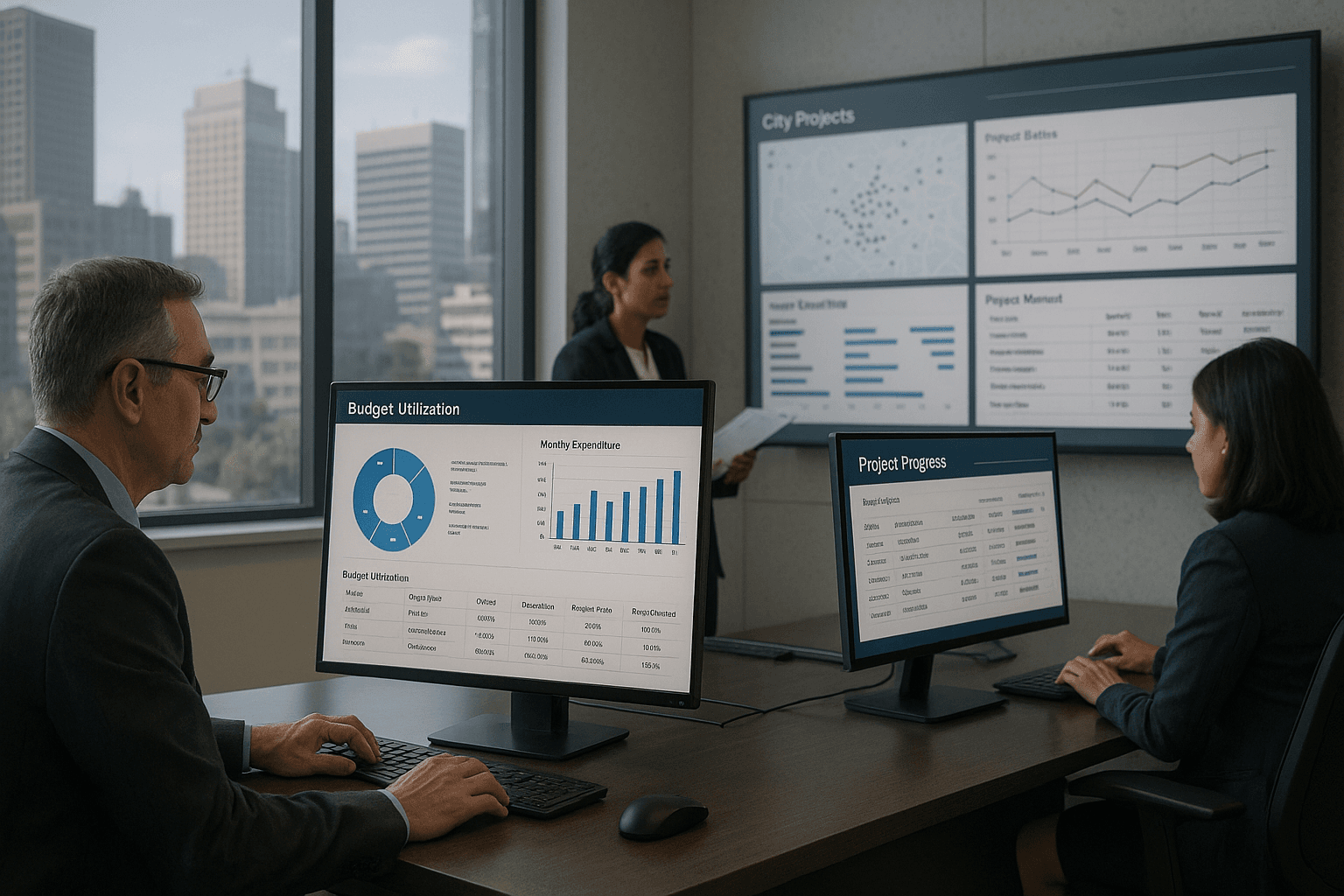
For senior leadership, the ERP’s analytics dashboard became a strategic command center — giving them real-time control over 2,000+ projects and instant policy insights.
Most importantly, citizens began to see the difference — quicker responses, transparent data, and visible progress in civic development.
Governance and Compliance
Presear ERP was aligned with multiple governance frameworks:
ISO 27001 – Information Security Management
NIST AI Risk Management Framework
Government eMarketplace (GeM) Compliance
IT Act (India) and GFR 2017 Procurement Rules
Data Residency Compliance (NIC / MeitY guidelines)
Regular penetration tests, API audits, and role-based access controls ensured that security was not just an add-on, but a foundation.
Strategic Impact
1. Policy Agility
Real-time analytics empowered the department to re-prioritize projects mid-cycle based on progress and citizen demand.
2. Transparency and Trust
By opening data to citizens through the public dashboard, the department demonstrated accountability — building credibility and public goodwill.
3. Data-Driven Decision-Making
AI insights replaced intuition with evidence. Leaders could now simulate budget outcomes and predict project bottlenecks months in advance.
4. Inter-Departmental Synergy
Integration with finance, procurement, and HR systems created a unified governance fabric — eliminating redundancy and improving collaboration across administrative silos.
Sustainability and Future Readiness
Presear ERP also advanced the department’s sustainability goals:
Reduced paper usage by 90% through digital workflows.
Minimized idle capital in stalled projects.
Enabled predictive maintenance of public assets to reduce resource wastage.
Presear’s roadmap for the department includes:
AI-Powered Citizen Chatbot for 24x7 service queries,
Computer Vision Integration for on-site project verification, and
Cross-Departmental Data Lakes for integrated city planning analytics.
Conclusion
The success of this project represents a new model for smart governance — where transparency, efficiency, and intelligence coexist in harmony.
By implementing Presear ERP – Governance Edition, the civic administration transformed not only how it managed resources but how it engaged citizens.
Budgets became dynamic, procurement became fair, and data became public — all while maintaining the highest security and compliance standards.
At its core, this transformation was made possible because Presear Softwares built the ERP around a simple principle:
“Governance data should be alive — always visible, auditable, and intelligent.”
With Python at its foundation, AI at its heart, and governance at its soul, Presear ERP is setting the benchmark for the next generation of digital public administration.
Developed by the Enterprise AI Division, Presear Softwares
Engineering intelligent, transparent, and accountable governance ecosystems through AI-driven ERP innovation.