Conversational Quantum Drug Discovery Using Voice AI and Amazon Braket
A Hybrid Architecture for Voice-Driven Molecular Simulation and Quantum Chemistry Experiments
Presear excels at building softwares that are functional and capable enough to stand with your business logic with a thin line between the functional requirements as well as standard features. Our softwares are built as commercial products which further helps in ensuring the branding and the smoothness for a better user experience. Not every software that is built every day around the world is used 100%, but Presear tries to achieve an average of 95% usability with its software exports. We also take pride in providing one of the best software maintenance support even after your project delivery to ensure you don’t face extra overheads and concentrate more on your business rather than technical issues. Our strong QA & Testing system ensures proper iteration as well as efficiency with the software code, thereby making it fault-tolerant and reliable.
Drug discovery is one of the most complex computational challenges in modern science. The process of identifying new therapeutic molecules involves evaluating chemical stability, predicting molecular interactions, and estimating binding affinities with biological targets. These tasks rely heavily on quantum mechanical calculations, which quickly become computationally expensive when performed on classical systems.
Traditional computational chemistry methods often approximate molecular behavior due to limitations in classical processing power. However, the emergence of quantum computing platforms introduces a new paradigm for simulating molecular systems with higher fidelity.
At the same time, advances in conversational AI are transforming how researchers interact with computational infrastructure. Instead of manually configuring complex simulation pipelines, scientists can increasingly interact with systems using natural language and voice interfaces.
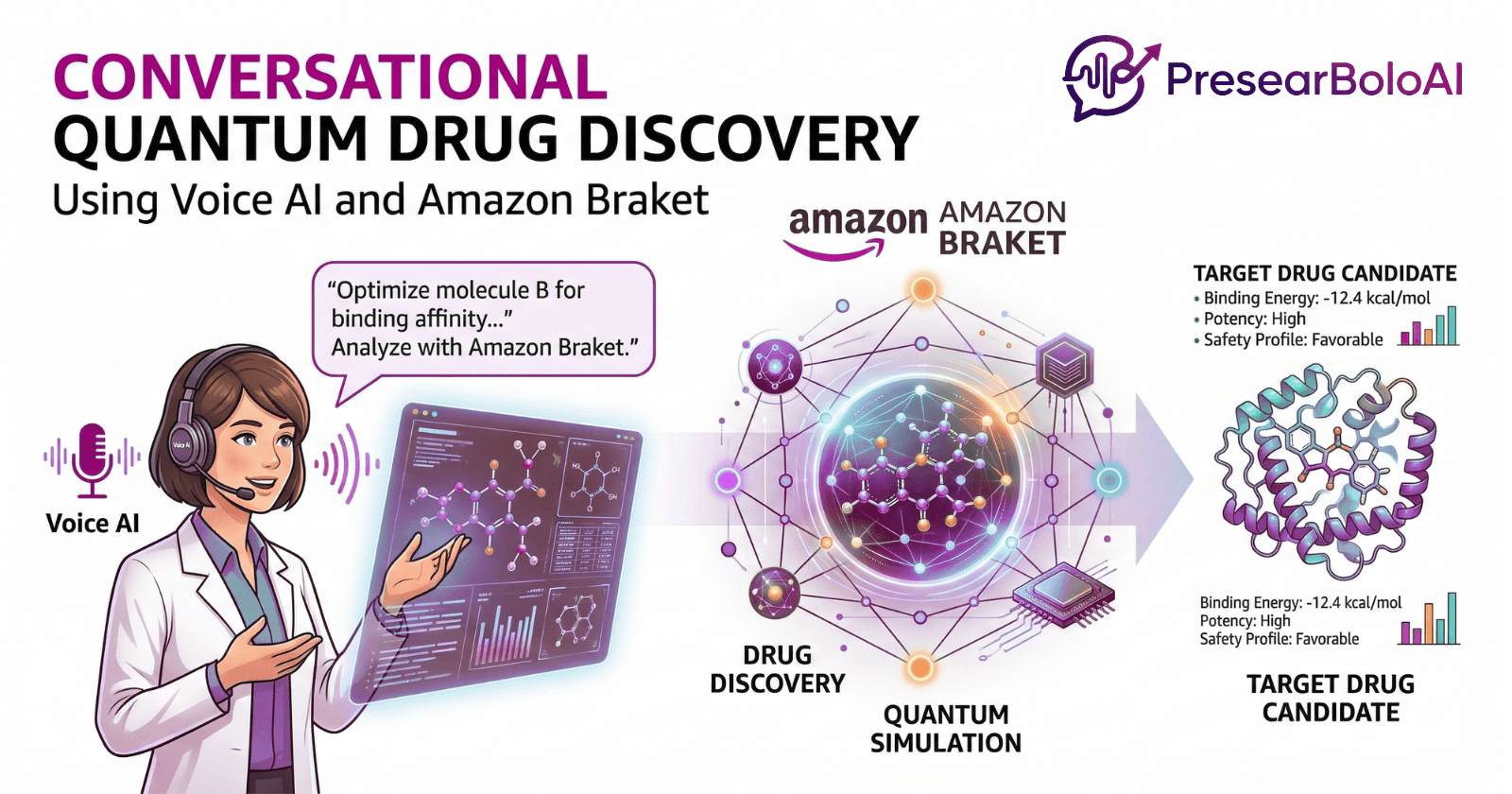
This article presents a hybrid architecture developed conceptually by Presear that integrates conversational voice interfaces with quantum molecular simulation. The platform uses Presear Dakshini, Presear’s voice AI stack, to enable natural language interaction with quantum simulations executed through Amazon Braket. The result is a conversational research environment where scientists can initiate molecular experiments simply by speaking.
The Vision: Conversational Scientific Computing
Scientific computing platforms traditionally require domain experts to configure simulation parameters manually. Molecular simulations typically involve complex steps such as:
defining molecular structures
selecting simulation algorithms
configuring Hamiltonian operators
executing optimisation routines
These processes require significant technical expertise and often involve multiple software tools.
The proposed system introduces the concept of conversational scientific computing, where a researcher communicates with the simulation environment using voice commands. The system interprets the scientific query, translates it into a structured molecular simulation problem, and executes quantum algorithms to estimate molecular properties.
System Architecture Overview
The architecture combines three primary layers:
Conversational interface powered by Presear Dakshini
Molecular simulation preparation engine
Quantum simulation layer executed through Amazon Braket
Together, these components create a seamless pipeline that converts spoken research queries into executable quantum simulations.
Conversational Interface Layer: Presear Dakshini
The front-end of the system is powered by Presear Dakshini, Presear’s conversational voice AI stack designed for intelligent interaction with complex digital systems.
Presear Dakshini performs several key functions:
speech-to-text conversion
natural language understanding
scientific intent detection
parameter extraction from voice queries
Researchers interact with the system through natural language commands.
Example interaction:
“Simulate the stability of a modified benzene derivative interacting with a protein binding site.”
The system captures the spoken command and processes it through Dakshini’s language understanding engine. The model identifies:
molecular structure references
simulation objectives
experimental parameters
The extracted information is then passed to the molecular simulation preparation layer.
This conversational interface dramatically simplifies interaction with advanced computational workflows.
Molecular Simulation Preparation Layer
Once the voice query is interpreted, the system converts the scientific request into a structured computational problem.
This stage includes several steps:
Molecular Representation
The system constructs a digital representation of the molecule using formats such as:
molecular graphs
atomic coordinate structures
basis function representations
Hamiltonian Construction
The molecular system is encoded into a quantum mechanical Hamiltonian that represents the energy interactions between electrons and nuclei.
This Hamiltonian forms the basis for quantum simulation.
Quantum Circuit Preparation
The Hamiltonian is mapped into a quantum circuit representation that can be executed on quantum processors. Techniques such as fermion-to-qubit mapping are applied to represent electronic states within qubit registers.
The resulting circuit represents the molecular system that will be simulated using quantum algorithms.
Quantum Simulation Layer Using Amazon Braket
The prepared simulation task is executed through Amazon Braket, a cloud-based quantum computing platform that provides access to quantum hardware and high-performance simulators. Amazon Braket enables researchers to experiment with quantum algorithms designed for molecular simulation and quantum chemistry.
In the proposed system, algorithms such as the following may be applied:
Variational Quantum Eigensolver (VQE)
The Variational Quantum Eigensolver is a hybrid quantum-classical algorithm used to estimate the ground-state energy of molecular systems. It uses parameterized quantum circuits combined with classical optimisation routines to approximate molecular energy levels.
Quantum Phase Estimation
Quantum Phase Estimation provides a method for estimating eigenvalues of unitary operators, which can be applied to molecular Hamiltonians to determine energy states.
Hybrid Quantum-Classical Optimisation
Due to current hardware limitations, many quantum chemistry simulations use hybrid approaches where quantum circuits evaluate energy states while classical optimizers update circuit parameters.
Amazon Braket allows these algorithms to run either on quantum simulators or on actual quantum hardware provided by integrated quantum computing providers.
Workflow of the Conversational Quantum Simulation System
The complete workflow transforms a spoken research query into a quantum simulation experiment.
The researcher issues a voice command through the conversational interface.
Presear Dakshini converts speech to text and extracts the scientific intent.
The molecular simulation preparation engine constructs a Hamiltonian representation of the molecule.
Quantum circuits representing the molecular system are generated.
The simulation is executed using Amazon Braket quantum algorithms.
Energy states and molecular properties are computed.
Results are interpreted and returned through the voice interface.
This pipeline allows researchers to perform sophisticated quantum simulations without manually configuring complex computational workflows.
Consider a pharmaceutical researcher exploring potential molecular modifications to improve binding affinity with a target protein.
The researcher speaks:
“Evaluate the stability of a hydroxyl-modified variant of compound C interacting with the target enzyme.”
The system processes the query and performs the following steps:
identifies the molecular modification
constructs a Hamiltonian describing the electronic interactions
executes a quantum simulation through Amazon Braket
estimates the ground-state energy of the modified molecule
The system then returns an explanation through the voice interface:
“The modified compound demonstrates lower ground-state energy compared to the baseline structure, indicating increased thermodynamic stability. Binding potential with the target enzyme is predicted to improve.”
This conversational interaction enables scientists to rapidly test molecular hypotheses.
Advantages of the Hybrid Architecture
The integration of conversational AI and quantum simulation introduces several advantages.
Natural Interaction with Quantum Systems
Researchers interact with complex quantum simulations using natural language rather than configuring technical workflows.
Accelerated Molecular Exploration
Quantum simulations provide more accurate modelling of molecular interactions, enabling faster exploration of candidate compounds.
Reduced Computational Complexity for Researchers
Automation of Hamiltonian construction and circuit preparation simplifies the process of setting up quantum chemistry experiments.
Scalable Cloud-Based Infrastructure
The entire system operates through cloud infrastructure, allowing researchers to scale simulations without managing specialised hardware.
Potential Applications
While the primary use case focuses on pharmaceutical drug discovery, the architecture can support multiple research domains including:
protein–ligand interaction analysis
catalyst design
advanced material development
battery chemistry research
chemical reaction pathway simulation
These fields rely heavily on molecular simulations and could benefit from conversational interfaces for quantum computation.
As quantum hardware matures, the accuracy and scale of molecular simulations will continue to improve. Larger qubit counts and improved error correction techniques will enable simulation of increasingly complex molecular systems.
Future iterations of conversational quantum platforms may incorporate:
automated molecular generation
reinforcement learning for molecule optimisation
integration with laboratory automation systems
Such systems could ultimately support fully autonomous molecular discovery pipelines.
The convergence of conversational AI and quantum computing presents a new approach to scientific computing. By integrating Presear Dakshini, Presear’s voice AI stack, with quantum molecular simulation executed through Amazon Braket, researchers gain an intuitive interface for interacting with advanced computational chemistry tools.
This hybrid architecture demonstrates how conversational systems can simplify access to quantum computing while enabling more efficient exploration of molecular structures and interactions.
As quantum technologies continue to evolve, voice-driven research platforms like this may become an essential component of next-generation scientific discovery environments.