Regulatory Change Monitoring — A Use Case for Presear Softwares PVT LTD

I
Head (AI Cloud Infrastructure), Presear Softwares PVT LTD
Search for a command to run...
Head (AI Cloud Infrastructure), Presear Softwares PVT LTD
No comments yet. Be the first to comment.
Explore the forefront of AI innovation with Presear Softwares' AI Series, delving into machine learning for automation and neural networks for predictive analytics, unlocking AI's transformative potential across industries.
How Presear Softwares Empowered the National Institute of Wind Energy with Intelligent Asset Tracking

An ICSSR Project Implementation by Presear Softwares
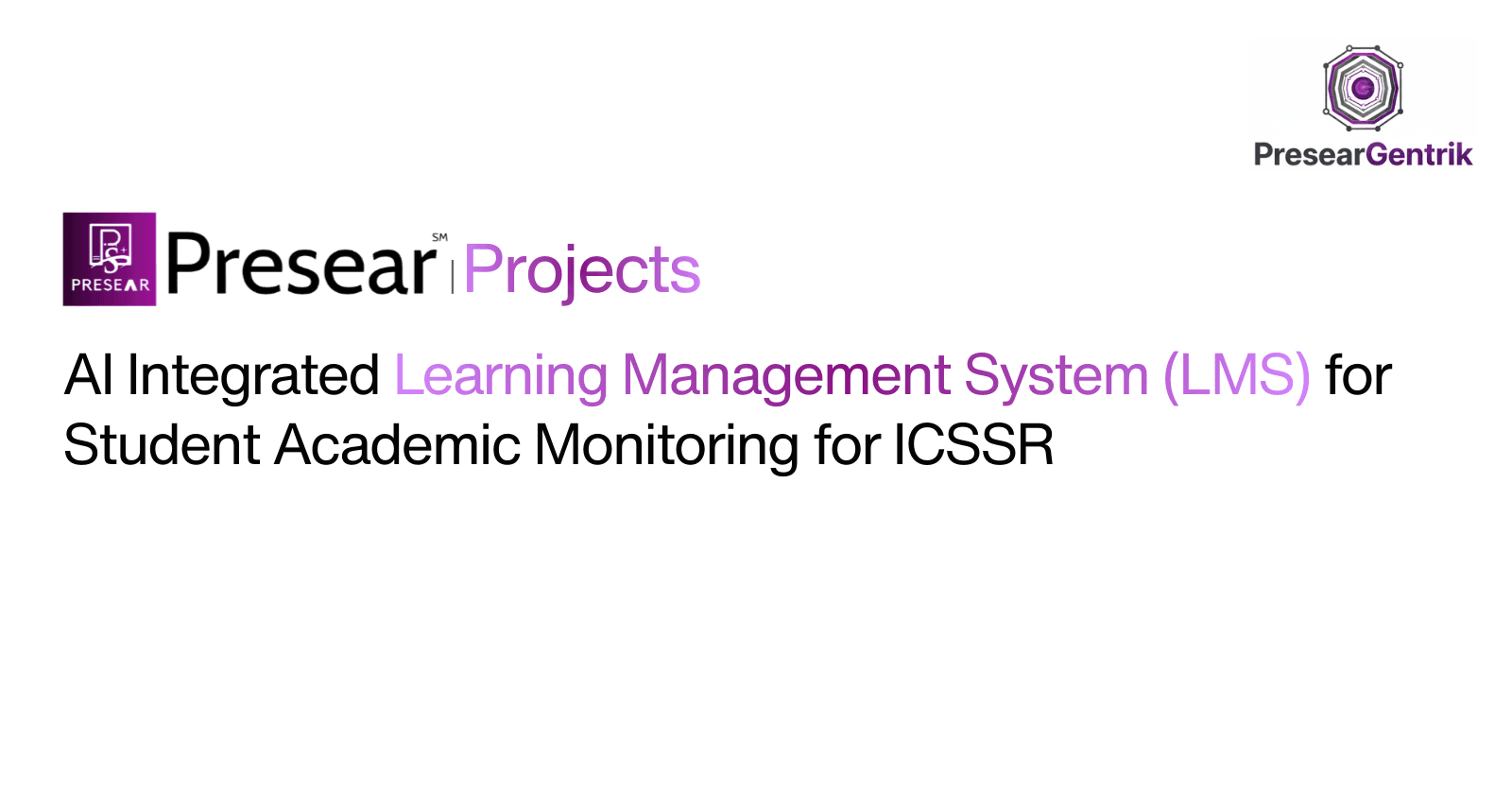
A Hybrid Architecture for Voice-Driven Molecular Simulation and Quantum Chemistry Experiments
How PresearVisionXTrans™ Can Secure Large Gatherings like Holi

How Presear Engineered a Burst-Resilient Government Recruitment Portal using AI-Ready Scalable Architecture
On this page
Overview
Regulatory landscapes change rapidly. New laws, amendments, guidelines, circulars, and court decisions arrive across multiple jurisdictions and industry regulators, and organizations must track, interpret, and operationalize those changes quickly to avoid fines, reputational damage, and business disruption. Presear Softwares PVT LTD offers a scalable, intelligent Regulatory Change Monitoring (RCM) solution that automates continuous regulatory surveillance, provides precise impact analysis, and streamlines compliance workflows — turning a costly, manual burden into a competitive advantage.
Keeping up with frequent regulatory updates is time-consuming, error-prone, and expensive. Compliance officers, legal teams, and risk managers must comb dozens of regulator websites, legal databases, gazettes, and industry newsletters — often in multiple languages — to ensure nothing material is missed. Manual approaches create latency between when a regulation is published and when business units act, increasing exposure to non‑compliance.
Key challenges include:
Volume & velocity: Regulators publish large numbers of documents daily.
Fragmentation: Sources are distributed across websites, PDFs, email alerts, and legacy systems.
Interpretation: Identifying which changes are relevant to a specific business or product is non-trivial.
Operationalization: Mapping regulatory changes into policies, control updates, and training workflows.
Auditability: Demonstrating timely detection, assessment, and remediation during inspections.
Presear’s RCM product is designed to address the full lifecycle of regulatory change management, from detection to decision to delivery. Core capabilities include:
Continuous Multi-Source Surveillance — automated ingestion from regulator portals, legal databases, government gazettes, and industry publications. Supports scheduled scraping, API-based feeds, RSS, email parsing, and manual upload of advisory PDFs.
Intelligent Document Processing — OCR and natural language processing (NLP) extract structured metadata (jurisdiction, regulator, effective date, document type), full-text, and semantic summaries from PDFs and web pages.
Change Classification & Relevance Scoring — machine-learned models classify documents (e.g., legislation, guidance, circular) and score relevance for the client’s business lines and products based on configurable rules and historical mappings.
Impact Analysis & Mapping — automated mapping that suggests impacted controls, policies, standard operating procedures (SOPs), and affected business units. Presear leverages taxonomies (e.g., GDPR, Basel, RBI directions) and customizable rule-sets to provide prioritized recommendations.
Workflow & Case Management — creates compliance cases with assignments, due dates, evidence capture, and activity logs. Integrates with ticketing tools (Jira, ServiceNow) and GRC platforms.
Collaboration & Notifications — targeted alerts via email, Slack/MS Teams, and mobile push notifications. Stakeholders receive concise impact summaries and recommended next steps.
Audit Trail & Reporting — immutable logs of detection, analyst assessments, actions taken, and closure. Standard and ad-hoc compliance reports for audit and senior management.
Localization & Multi-Jurisdiction Support — supports multiple languages, time zones, and local legal conventions to serve multinational enterprises.
Domain-first AI: Presear’s models are trained on regulatory corpora and tuned for legal/regulatory language, giving higher accuracy in classification and entity extraction compared to generic NLP models.
Configurable Relevance Engine: Unlike one-size-fits-all monitors, Presear allows compliance teams to define custom rule-sets, business unit mappings, and risk weightings so alerts are aligned to what truly matters for the client.
End-to-end Integration: The platform connects to enterprise systems (GRC, ticketing, DMS) so regulatory events automatically propagate into operational workflows.
Explainable Recommendations: Each suggested mapping to controls or policies is accompanied by evidence (text excerpts, similarity scores, and rationale) to support faster analyst decision-making and defensibility during audits.
Scalability & Security: Built on cloud-native architecture with role-based access control, encryption at rest/in transit, and tenancy options for data segregation.
Presear’s RCM typically follows a modular architecture:
Ingestion Layer — crawlers, connectors (APIs, RSS, email), and manual upload endpoints.
Document Processing Pipeline — OCR, NLP, language detection, entity extraction, and metadata enrichment.
Relevance & Impact Engine — model ensemble for classification, named‑entity linking, and business-rule evaluation.
Case & Workflow Engine — creates actionable tasks and integrates with downstream systems.
Presentation Layer — dashboards, alerts, reports, and analyst workbench.
Security & Audit — logging, SIEM integration, IAM.
Deployments can be cloud-hosted, private-cloud, or on-premises (for highly regulated clients). Presear supports hybrid models where sensitive data stays on-premise while non-sensitive processing runs in a secure cloud environment.
A pragmatic rollout ensures rapid value and low disruption. A typical program follows four phases:
Discovery & Source Mapping (2–4 weeks)
Identify regulatory sources, business lines, and key stakeholders.
Collect sample documents and existing policy/control taxonomies.
Pilot & Rules Tuning (6–8 weeks)
Configure ingestion for 3–5 critical regulators.
Tune relevance models with client-specific examples and set up initial workflows.
Deliver measurable KPIs: time-to-detect, false positive rate, and analyst throughput.
Scale & Integrate (2–4 months)
Expand to full set of jurisdictions.
Integrate with GRC, DMS, HR systems for policy updates and training triggers.
Configure role-based access and audit reporting.
Optimize & Govern (ongoing)
Continuous model retraining, post-implementation reviews, and change-control process for rule updates.
Monthly/quarterly health checks and a governance forum for tuning risk thresholds.
Presear’s RCM delivers concrete benefits:
Faster Time-to-Detect: Automated surveillance reduces detection latency from days/weeks to hours — enabling proactive compliance.
Resource Efficiency: Automating routine monitoring and classification reduces manual effort, allowing compliance analysts to focus on high-value interpretation and remediation.
Reduced Regulatory Risk: Early detection and prioritized workflows reduce the window of exposure and likelihood of fines or corrective actions.
Operational Consistency: Standardized mappings and workflows ensure consistent treatment of similar regulatory events across business units.
Audit Readiness: Complete audit trails and explainable impact analysis simplify audits and regulatory inquiries.
A conservative ROI example: a mid-sized financial institution with a team of 8 compliance analysts spends ~30% of their time on manual monitoring and triage. Automating 70% of that work can free 1.7 full-time equivalent (FTE) analysts for strategic tasks, while reducing average detection-to-action time by more than 60% — often paying back the solution cost within 9–14 months, depending on licensing and integration effort.
Client: National Payments Bank (NPB)
Problem: NPB operates across 10 states and struggled to track rapidly changing payments guidance issued by the central bank and multiple state regulators. Manual monitoring resulted in missed circulars and inconsistent policy updates.
Solution: Presear deployed an RCM pilot focusing on payments-related regulators and integrated the platform with NPB’s GRC tool and intranet. Presear configured relevance rules specific to retail payments, AML checks, and digital wallets.
Outcome: Within three months, NPB reduced manual monitoring hours by 58%, improved time-to-action for high-priority circulars from 5 days to 10 hours, and achieved measurable consistency in policy updates across 18 affected SOPs. During the subsequent regulatory inspection, NPB produced a complete audit trail showing timely detection and remediation for all applicable circulars.
False Positives/Negatives: No model is perfect. Presear emphasizes human-in-loop workflows and transparent scoring so analysts can validate and correct mappings quickly.
Data Privacy: When processing jurisdictional or personal data, deployments follow local privacy regulations and offer data residency controls.
Change Control: Regulatory taxonomies and business rules must be governed within a formal change-control process to avoid inconsistencies.
Third-party Dependency: For critical feeds, Presear recommends redundancy (multiple ingestion methods) and contractual SLAs with data providers.
Run a 6–8 week pilot with a focused set of regulators and business lines to establish baseline KPIs.
Inventory your regulatory sources and provide samples to Presear for model tuning.
Map critical controls and policy owners to accelerate impact mapping and remediation workflows.
Plan integration points (GRC, ticketing, DMS) early to maximize operational value.
Establish governance: appoint a Regulatory Change Owner and monthly review cadence.
Regulatory change monitoring is no longer an optional compliance activity — it’s central to risk management and business continuity. Presear Softwares PVT LTD’s RCM solution transforms scattered, manual monitoring into a robust, auditable, and efficient process that reduces risk, lowers costs, and enables faster, evidence-backed decisions.
For compliance officers, legal teams, and risk managers facing mounting regulatory complexity, Presear offers a pragmatic, proven path to staying ahead of change. To explore a pilot tailored to your industry and jurisdictions, contact Presear Softwares PVT LTD for a consultation and roadmap.
Prepared by Presear Softwares PVT LTD — Regulatory Solutions Team.