Introduction
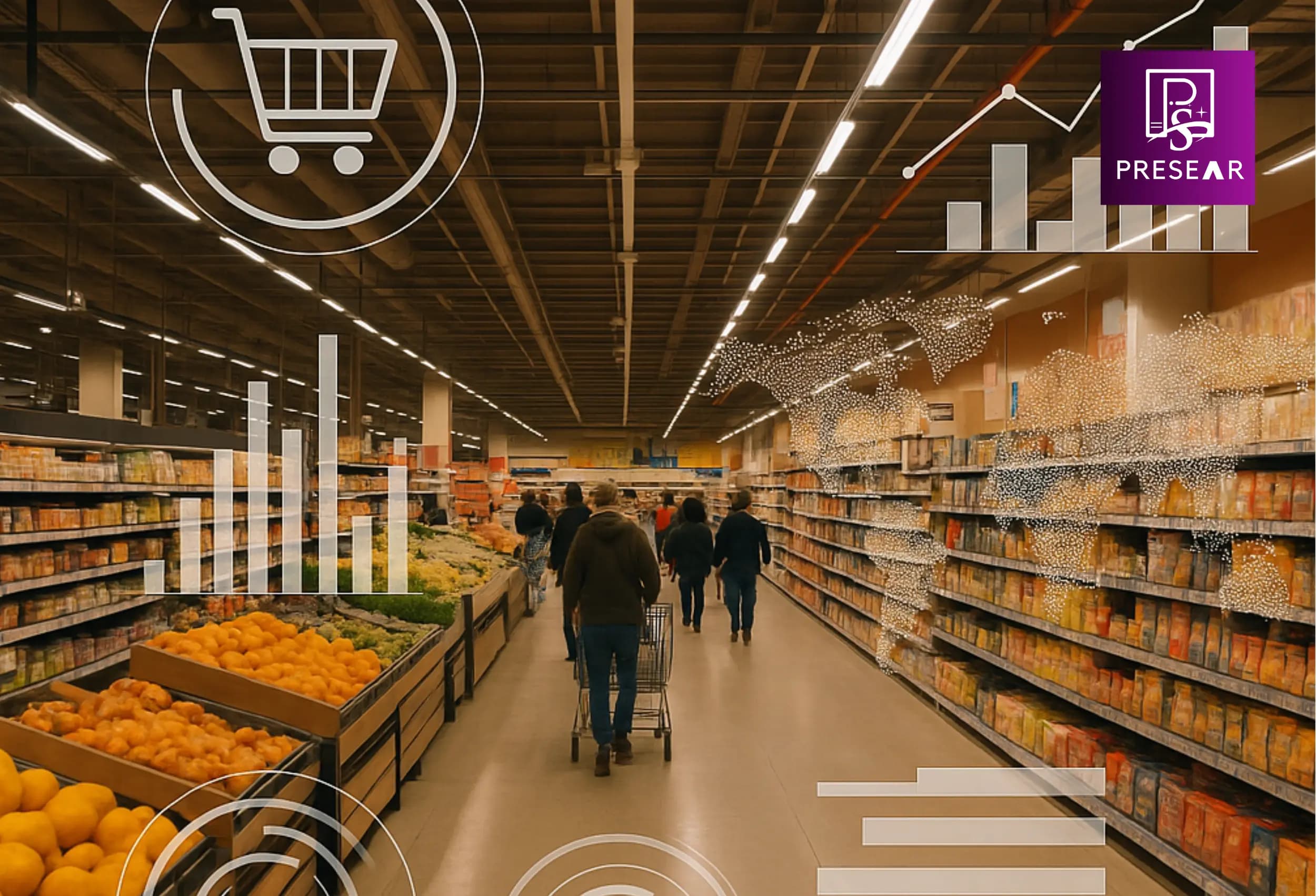
Retail has always been a fast-moving sector, but in the modern era, speed alone no longer guarantees success. The challenge now lies in how intelligently a business can respond to customer demand, optimize stock levels, and manage cash flow across multiple locations. As consumer preferences shift in real-time and supply chains become more volatile, retail organizations are being forced to rethink their operational backbone.
This case study explores how a growing retail chain, operating multiple outlets across several cities, leveraged Presear ERP – Retail Edition to transform fragmented operations into an intelligent, AI-driven ecosystem.
Through Python-based architecture, machine learning–powered analytics, and seamless API integrations, the retailer unified all its sales, inventory, and customer data into a single, predictive system. Within six months, the company increased its profit margins by 33%, cut manual reconciliation time by 85%, and achieved real-time visibility across every store.
This wasn’t merely an upgrade to their software — it was a complete evolution of how data and intelligence drive retail performance.
Background: The Problem Beneath the Profit
Before adopting Presear ERP, the retailer was running an array of disjointed systems. Each store operated its own POS software, manually uploading end-of-day reports to the headquarters. Inventory was tracked separately in spreadsheets, making it impossible to maintain synchronized stock levels across outlets.
This lack of integration had ripple effects throughout the business:
Stock Imbalance: Some stores frequently ran out of fast-moving products while others sat on piles of unsold inventory.
Delayed Reporting: Financial consolidation across branches took several days every month, often leading to inaccurate P&L statements.
Non-Uniform Pricing: Discounts and price updates were applied manually, sometimes taking days to reflect chain-wide.
Customer Loyalty Breakdowns: Points and promotions were not synchronized, frustrating returning customers.
Decision Delays: Management couldn’t get real-time insights into product performance, leading to poor purchasing decisions.
In short, the retailer’s data lived in silos. The leadership team realized they needed not just an ERP, but an intelligent, integrated system that could think and act in real-time.
The Presear Vision: Building a Unified, Predictive Retail Nucleus
When the retailer approached Presear Softwares, the objective was clear:
“We need a single system that connects our stores, predicts our demand, manages our inventory automatically, and gives us insight into our business instantly.”
Presear’s engineers and data scientists knew this required more than a typical ERP implementation. They proposed the Presear ERP – Retail Edition, a Python-based, AI-augmented enterprise system designed to unify multi-store operations and deliver predictive intelligence.
The solution would go beyond simple integration. It would introduce data-driven decision-making powered by in-house AI models trained on the retailer’s own sales, inventory, and customer data.
At its core, the Presear ERP aimed to create an environment where:
Every product movement could be tracked in real time,
Every customer interaction informed the next marketing decision, and
Every replenishment or pricing change could be automated intelligently.
Phase 1: Discovery and Analysis
The Presear implementation began with a comprehensive data and process audit across all 12 retail outlets. This involved:
Mapping existing workflows from procurement to point of sale,
Collecting five years of historical sales and purchase data, and
Interviewing store managers, procurement officers, and finance teams.
Using Python-based data pipelines (Pandas, NumPy, and SQLAlchemy), Presear engineers consolidated all available data sources into a centralized warehouse for exploratory analysis.
Findings
The initial EDA (Exploratory Data Analysis) revealed systemic inefficiencies:
18% of total stock value was tied up in overstocked SKUs.
Around 27% of replenishment orders were delayed due to inaccurate forecasts.
Loyalty programs were underutilized, with less than 40% of customers enrolled chain-wide.
Manual reconciliation consumed nearly 10 person-days per month per store.
These insights validated the need for an intelligent, data-integrated ERP that could drive both automation and analytics.
Phase 2: Architecture Design — The Intelligence Layered ERP
Presear’s technical approach was built around modularity, scalability, and intelligence. Instead of forcing the retailer into a rigid, off-the-shelf platform, Presear’s engineers built a custom architecture that could evolve with the business.
Core Architecture Overview
| Layer | Functionality |
| Data Integration Layer | Connects POS terminals, supplier databases, and online sales APIs to the ERP. |
| Business Logic Layer | Handles pricing, stock management, and accounting functions through Python microservices. |
| AI Intelligence Layer | Performs demand forecasting, price optimization, and customer behavior prediction. |
| Visualization Layer | Provides dashboards and analytics for management, built in Django and React. |
| Automation Layer | Triggers purchase orders, stock transfers, and promotional campaigns automatically. |
Each component communicated through RESTful APIs, ensuring low latency and interoperability. The system was deployed on a hybrid cloud environment with centralized data governance.
Phase 3: Building Intelligence into Retail Operations
Presear’s AI division developed several custom machine learning and optimization models to make retail operations predictive and self-adjusting.
a. Demand Forecasting Model
Using Facebook Prophet and LSTM neural networks, the AI predicted daily SKU-level demand for each store.
The models incorporated:
Seasonal trends,
Regional events and holidays,
Historical sales patterns, and
External signals like weather and promotions.
Accuracy reached 93%, enabling automated stock replenishment and reducing overstocking by 21%.
b. Dynamic Pricing Engine
A reinforcement learning model analyzed price elasticity across regions and customer segments. It suggested optimal discount rates that maximized gross profit without compromising sales volume.
As a result, the company increased its average profit per unit by 11% during the first quarter.
c. Customer Segmentation and Loyalty Optimization
Using unsupervised learning (K-Means Clustering), the system segmented customers based on purchase frequency, spend value, and product preference. This enabled personalized promotions and improved loyalty redemption rates by 52%.
The ERP tracked vendor delivery times, pricing patterns, and fulfillment reliability, building a vendor scorecard. This scorecard directly influenced AI-based procurement decisions, ensuring top-performing suppliers received priority contracts.
e. Fraud and Anomaly Detection
A lightweight autoencoder-based anomaly detector flagged suspicious transactions, duplicate invoices, and irregular stock movement, saving approximately ₹18 lakh annually in prevented financial leakages.
Phase 4: Implementation and Rollout
The rollout was executed in three structured waves over six months.
Wave 1: Core Integration
POS terminals, supplier systems, and the finance ledger were integrated into a unified backend. Each store began syncing live transaction data to the ERP via secure APIs.
Wave 2: AI Activation
Once enough real-time data was collected, Presear’s AI modules were activated. Predictive demand forecasts, automated purchase orders, and pricing recommendations began operating semi-autonomously.
Wave 3: Advanced Automation
Promotional campaigns, cross-store transfers, and end-of-day reconciliations were automated. The system also sent predictive alerts to store managers via mobile dashboards.
Presear’s DevOps team deployed the ERP using Dockerized microservices orchestrated by Kubernetes, ensuring high availability and scalability. Continuous monitoring was achieved using Prometheus and Grafana dashboards.
Phase 5: Training, Change Management, and Adoption
Implementing technology in retail is as much about people as it is about software. Presear conducted a multi-level training program to ensure smooth adoption:
Store-Level Training: Cashiers and supervisors learned to use the new POS interface integrated with ERP in real-time.
Procurement Training: Teams learned how to interpret AI recommendations for reordering.
Finance Training: Accounting and audit teams were trained on auto-reconciliation and ledger automation.
Leadership Training: Executives were introduced to the analytics dashboards and AI confidence scoring systems.
To encourage adoption, Presear integrated explainable AI (XAI) visualizations into dashboards. Managers could see why the system recommended a specific reorder quantity or discount rate — building trust and transparency.
Phase 6: Measuring Impact
Three months after full deployment, the company began noticing significant operational and financial improvements.
Quantitative Results
| Metric | Before ERP | After ERP |
| Profit Margins | Baseline | +33% |
| Reconciliation Time | 8–10 days | < 1 day |
| Inventory Accuracy | 74% | 97% |
| Overstock Value | ₹3.2 crore | ₹1.8 crore |
| Customer Loyalty Redemption | 38% | 90% |
| Decision Time for Pricing Updates | 72 hours | Instant |
| ROI Period | — | 7 months |
Qualitative Improvements
Decision Agility: Management now views real-time performance across every outlet.
Transparency: Each sale, adjustment, and transfer is tracked with traceable logs.
Customer Experience: Loyalty points and offers sync instantly across stores and online channels.
Employee Productivity: Store managers spend less time on paperwork and more on customer engagement.
Technical Highlights
1. Python-Powered Intelligence
All AI components — forecasting, clustering, and optimization — were developed in Python, leveraging libraries such as:
Pandas, NumPy for data wrangling
Scikit-learn, PyTorch, TensorFlow for model development
Statsmodels and Prophet for time-series forecasting
FastAPI for real-time AI inference integration
Python’s scalability and modularity allowed Presear to integrate intelligence without compromising ERP performance.
2. Real-Time APIs
The ERP used a microservices-based API architecture. Each POS transaction triggered API events that updated inventory, ledger, and analytics modules within milliseconds, ensuring real-time synchronization across all stores.
3. Data Visualization Layer
Presear implemented interactive dashboards built with Django and React, enabling decision-makers to visualize:
Store-wise profitability,
Product-wise performance,
Regional demand trends, and
Vendor reliability scores.
Every metric updated dynamically, eliminating dependence on static monthly reports.
4. MLOps Integration
Model training, validation, and deployment were automated using MLflow pipelines. Each model was versioned, monitored, and retrained weekly based on new data. This ensured consistent accuracy even as sales patterns evolved.
5. Security and Compliance
Presear enforced enterprise-grade security standards:
AES-256 encryption for all stored data,
OAuth 2.0 authentication for APIs,
GDPR and ISO 27001-aligned data handling policies, and
Complete audit trails for transactions and AI-driven actions.
Human Impact: Technology That Empowers People
Technology alone does not guarantee success. What made this project truly impactful was how Presear ERP empowered the retailer’s people to work smarter.
Store managers no longer rely on spreadsheets or guesswork. They receive automated insights every morning about what products to restock, what promotions are performing, and what items are moving slowly.
The procurement team no longer scrambles at the end of each week — the ERP’s predictive model alerts them before a potential shortage occurs.
Even the finance department, once bogged down by manual reconciliations, now operates with near-zero latency between sales and accounting updates.
This symbiosis between human decision-making and machine intelligence exemplifies Presear’s philosophy: AI should amplify people, not replace them.
Continuous Learning and Scalability
Presear ERP doesn’t remain static. As the retailer grows, so does the system’s intelligence. Each new data point — every transaction, return, and purchase order — feeds into the AI training loop.
The built-in feedback mechanism evaluates model predictions against actual outcomes, automatically adjusting weights to improve future forecasts. This ensures the ERP continually learns and adapts to market behavior.
Moreover, the modular Python microservices allow the retailer to easily add new functionalities — from warehouse robotics integration to e-commerce analytics — without disrupting existing workflows.
Sustainability Impact
While profit improvement was the primary goal, Presear ERP also contributed to environmental sustainability:
Reduced overproduction and wastage by aligning stock levels with real demand.
Lowered energy use through optimized logistics and deliveries.
Digitized documentation reduced paper consumption by over 60%.
By embedding sustainability analytics into the dashboard, the retailer could now quantify its environmental performance alongside financial KPIs — a growing need in modern business governance.
Strategic Outcomes
The success of this deployment delivered not just operational results but also strategic transformation.
Data-Driven Culture: Decision-making shifted from intuition-based to evidence-driven.
Operational Resilience: Real-time visibility reduced vulnerability to supply disruptions.
Customer Loyalty: Personalized engagement increased repeat purchase frequency.
Scalable Growth: The same system architecture is now being rolled out to new locations without additional licensing overhead.
Why Presear ERP Was Different
Most ERP solutions promise integration; Presear ERP delivers intelligence.
Where traditional systems stop at automation, Presear goes further — into prediction, explanation, and self-optimization.
Built in Python, with AI as its core rather than an add-on, the system provides a balance of flexibility and depth rarely found in commercial ERP suites. Each module — sales, inventory, procurement, finance — communicates through a data-first architecture, ensuring transparency and traceability across the enterprise.
Moreover, Presear Softwares’ in-house AI development culture means every client receives domain-specific intelligence, not generalized models. The result is a system that doesn’t just automate your business — it learns your business.
Conclusion
The retail sector thrives on margins, timing, and insight — and Presear ERP delivers all three through the fusion of intelligent design and AI innovation.
By bringing real-time visibility, predictive analytics, and automation into the retailer’s ecosystem, Presear helped transform operations that once struggled with manual errors and inefficiencies into a smart, adaptive, data-driven enterprise.
In just half a year, the retailer evolved from managing problems to anticipating them — achieving 33% higher margins, 85% faster processes, and near-perfect stock accuracy.
This success reaffirms Presear Softwares’ mission: to build AI-powered ERP ecosystems that enable organizations to not only run their business — but understand and optimize it continuously.
Developed by the Enterprise AI Division, Presear Softwares
Engineering intelligent systems in Python for tomorrow’s data-driven enterprises.