

LLM Assistants for Defence Communications
I
Head (AI Cloud Infrastructure), Presear Softwares PVT LTD
Search for a command to run...
Head (AI Cloud Infrastructure), Presear Softwares PVT LTD
No comments yet. Be the first to comment.
Explore the forefront of AI innovation with Presear Softwares' AI Series, delving into machine learning for automation and neural networks for predictive analytics, unlocking AI's transformative potential across industries.
How Presear Softwares Empowered the National Institute of Wind Energy with Intelligent Asset Tracking

An ICSSR Project Implementation by Presear Softwares

A Hybrid Architecture for Voice-Driven Molecular Simulation and Quantum Chemistry Experiments

How PresearVisionXTrans™ Can Secure Large Gatherings like Holi

How Presear Engineered a Burst-Resilient Government Recruitment Portal using AI-Ready Scalable Architecture
In modern operations, the difference between mission success and failure often comes down to time: how quickly commanders can share intent, how fast frontline units can report situational changes, and how reliably disparate systems exchange actionable information. Presear Softwares PVT LTD proposes a purpose-built LLM-driven assistant platform tailored for defence communications — a solution that shortens decision cycles, improves clarity under stress, and hardens information flows against operational friction.
This article describes the use-case, technical approach, operational benefits, security considerations, and an implementation roadmap for Presear’s LLM Assistants for Defence Communications. It is designed for defence planners, communications engineers, and program managers evaluating AI augmentation to communications stacks.
Defence communications face unique constraints:
Fragmented channels and protocols. Land, maritime, air, and cyber assets operate over different waveforms, message formats, and legacy systems. Passing information intact and quickly across these silos is nontrivial.
High noise, low bandwidth environments. Tactical radios, satellite links, and contested networks often have limited throughput and intermittent connectivity.
Cognitive overload. Commanders must parse streams of telemetry, voice reports, sensor feeds, and text messages — all under time pressure.
Language and jargon barriers. Multi-national coalitions and interdisciplinary teams use different terminologies and shorthand that can create misunderstandings.
Strict security and audit requirements. Communications must maintain confidentiality, integrity and non-repudiation while remaining auditable for after-action review.
These factors combine to create delays: messages queued for manual summarization, requests sent through slow translation or routing chains, or critical context lost between the sensor and the decision maker.
Presear’s LLM Assistant platform is an integratable, certified-grade software layer that sits alongside existing communications infrastructure and delivers three practical capabilities:
Intelligent message triage and summarization
Automatically ingests multi-modal inputs (voice-to-text from HF/VHF radios, secure chat messages, sensor telemetry) and produces concise, prioritised summaries annotated with confidence scores and timestamps.
Highlights actionable items (e.g., “Enemy UAV detected — bearing 312°, 3 km — immediate attention required”) so operators can act without reading full transcripts.
Adaptive, low-latency translation and normalization
Normalizes different message formats to a common canonical representation (structured fields for time, location, unit, intent).
Provides near-real-time translation and jargon normalization for multi-lingual / multi-domain teams, preserving tactical meaning rather than literal word-for-word rendering.
Context-aware assistance and decision support
Correlates incoming reports with mission plans, unit locations, and rules of engagement to flag contradictions, recommend courses of action, and surface relevant SOPs.
Maintains a short, mission-specific context window so the assistant's recommendations remain focused and relevant.
These capabilities are exposed through APIs, operator consoles, and light clients for constrained devices. The assistant is configurable for roles (e.g., airborne commander, maritime operator) and can be deployed in on-prem secured enclaves or ruggedised edge appliances when cloud connectivity is not permitted.
Presear’s recommended architecture balances speed, resilience and security:
Edge LLM instances on hardened appliances that sit at forward operating nodes. These instances handle immediate summarization, message compression, and preliminary intent extraction to reduce bandwidth usage.
Gateway federation layer that securely aggregates edge outputs, enforces routing policies, and performs cross-domain correlation.
Central command LLM cluster that maintains the authoritative mission context, long-term logs, and performs heavier analytics (pattern detection, after-action synthesis).
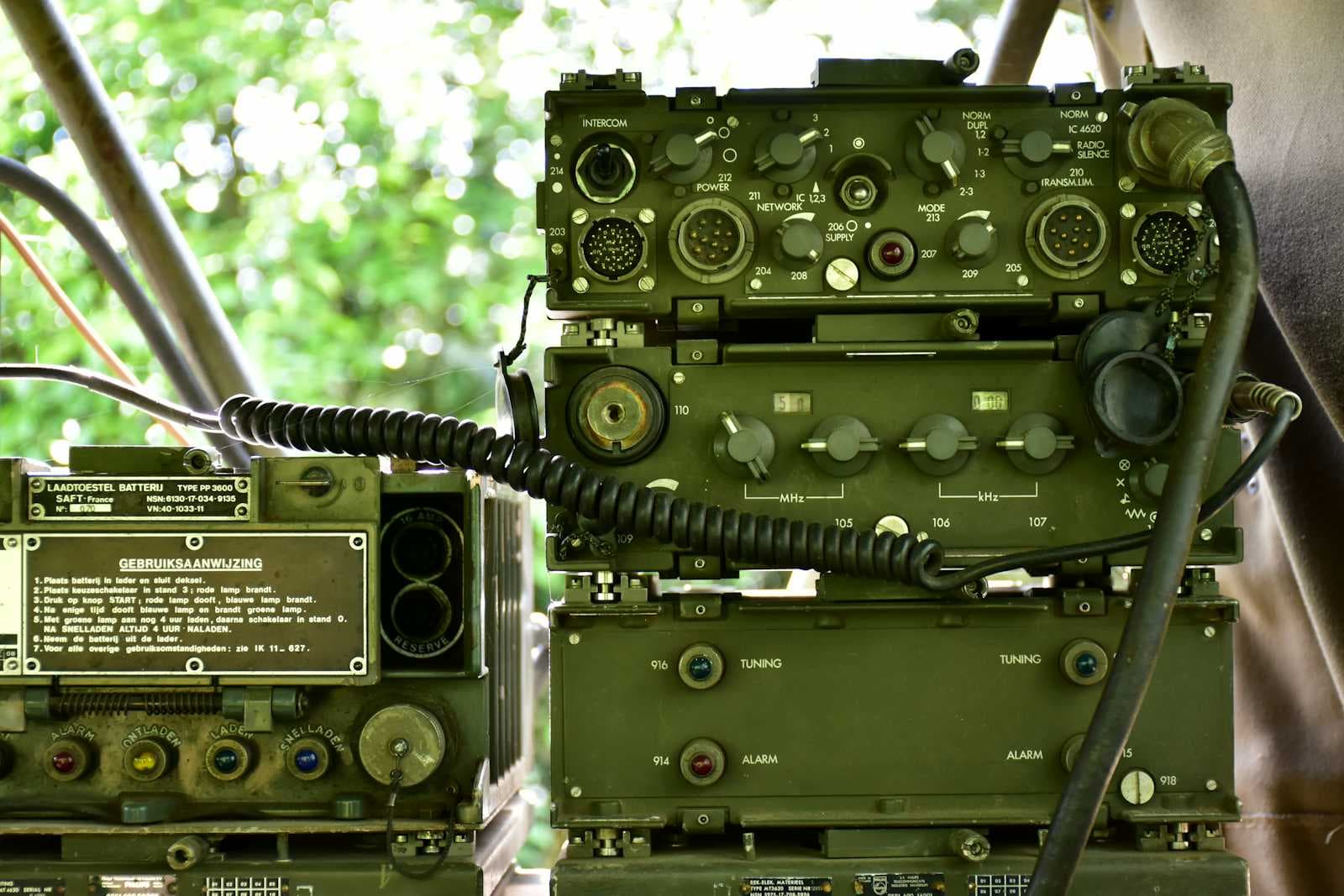
Connector modules to legacy comms (SATCOM, tactical radios, C2 messaging formats such as MIL-STD/STANAG where applicable), enabling transparent passthrough and canonicalization.
Crucially, the system supports store-and-forward semantics, graceful degradation (fallback to plaintext or preconfigured canned messages), and operate-offline modes with synchronized reconciliation once links restore.
Bandwidth-aware summarization: compresses transcripts into priority buckets so only the highest value content traverses constrained links.
Automatic transcription and noise filtering: converts voice traffic to cleaned text, removing channel artifacts and marking uncertain segments for verification.
Structured extraction: turns free text into fields (location, unit, time, threat type) that downstream systems can route and act upon automatically.
Secure knowledge retrieval: LLMs constrained to mission-specific knowledge bases (SOPs, ROEs, blue force locations) with strict access controls.
Explainability and audit trails: every assistant output is accompanied by provenance metadata — what sources were used, confidence levels, and why a recommendation was made — easing commander trust and post-mission analysis.
Rapid customisation: templates and prompt stacks that allow units to enforce local conventions, abbreviations, and message formatting rules.
When deployed correctly, Presear’s LLM Assistants produce tangible operational gains:
Reduced time-to-decision: automated triage and summaries reduce the time commanders spend sifting through unstructured messages, accelerating the observe-orient-decide-act loop.
Fewer communication collisions and retransmits: by compressing and normalizing messages, network congestion decreases and message delivery reliability improves.
Improved situational awareness: cross-correlation of multi-sensor inputs surfaces emergent threats earlier, enabling proactive rather than reactive responses.
Lower cognitive load on personnel: assistants handle routine classification, freeing humans to focus on higher-order judgment and complex tasks.
Enhanced interoperability: consistent canonical formats and jargon normalization reduce misinterpretation between allied units.
Metrics that Presear recommends tracking during trials include median message latency, percentage of messages auto-actioned, reduction in message retransmissions, and operator time spent on comms per shift.
Defence deployments require rigorous security:
Data sovereignty and host policy: Presear supports fully offline deployments for sensitive theatres — model weights and logs never leave the authorised enclave unless explicitly configured.
End-to-end encryption: message payloads remain encrypted while in transit and at rest; assistant outputs are signed and timestamped for non-repudiation.
Access control and role separation: fine-grained RBAC ensures only authorised roles can access decrypted content or influence mission context.
Model guardrails: LLM outputs are constrained by policy engines and validated against authoritative sources to prevent hallucinations or unsafe recommendations.
Auditability: immutable logs and explainable output traceability support compliance with operational oversight and legal frameworks.
Presear works in partnership with defence cyber teams to align with national and organisational standards, ensuring the assistant is treated as a certified communications aid rather than an unvetted automation.
Needs analysis & environment mapping (2–4 weeks): identify key comms flows, legacy systems, bandwidth constraints, and mission profiles.
Pilot deployment (6–12 weeks): small-unit pilot with an edge appliance and a central aggregator; tune summarization thresholds and connectors.
Operational evaluation: measure latency, operator acceptance, false positive/negative rates, and mission impact.
Iterative hardening: refine SOP integration, tighten security controls, and expand language/jargon packs.
Scale-out: roll to additional units, add federation between joint command centres, and integrate mission analytics.
Presear emphasises joint training: operators must learn how to read confidence indicators, validate assistant highlights, and annotate corrections — inputs that are fed back to continuously improve domain-specific models.
During an exercise, an airborne surveillance drone detects multiple fast-moving contacts. The edge LLM transcribes the drone operator’s voice report, distills it to: “Three contacts — small fast craft, bearing 220°, closing at 30 knots, last known grid X12345, probable hostile.” The assistant flags this as high priority and sends a two-line, template-formatted alert to the maritime command node. Commanders, already viewing correlated AIS and coastal radar data through the central LLM, receive a consolidated threat brief within seconds — not minutes — and can direct intercept assets with the correct ROE and navigation reference. Post-action, the assistant produces an annotated timeline for the after-action review, cutting reporting overhead dramatically.
Presear Softwares PVT LTD’s LLM Assistants for Defence Communications are designed to be pragmatic force multipliers: they do the heavy lifting of summarization, normalization, and context matching so human decision makers can act faster and with clearer situational awareness. By focusing on edge resilience, strict security, explainability, and incremental integration with legacy systems, Presear helps defence organisations modernise communications without disrupting proven workflows.
If your command centre, aerospace team, or communications unit is evaluating AI augmentation, Presear offers pilot packages, secure on-prem appliances, and integration frameworks to demonstrate concrete reductions in latency and operator workload — measurable outcomes that translate directly into improved mission effectiveness.