
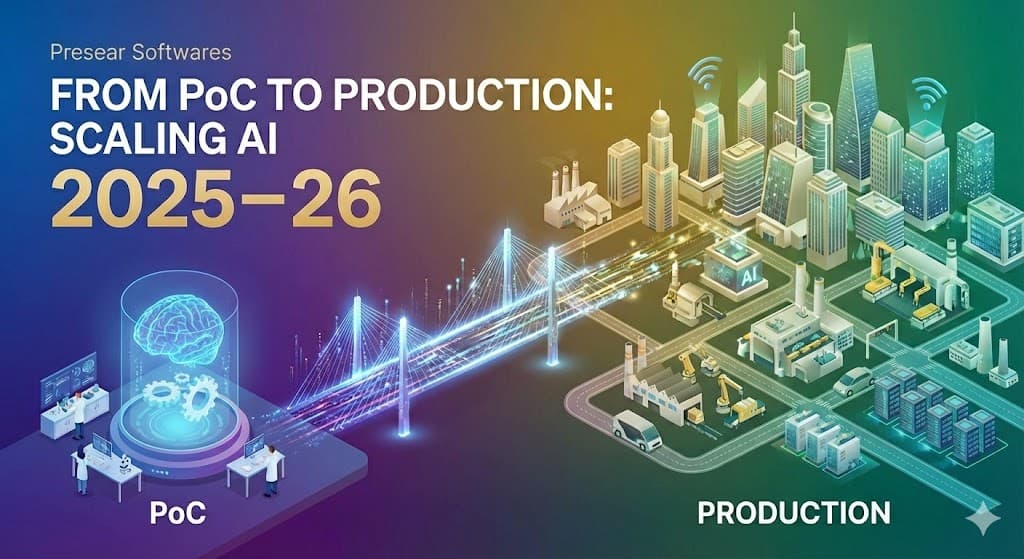
From PoC to Production: How Enterprises are Scaling AI in 2025–26
Search for a command to run...
No comments yet. Be the first to comment.
Explore the forefront of AI innovation with Presear Softwares' AI Series, delving into machine learning for automation and neural networks for predictive analytics, unlocking AI's transformative potential across industries.
How Presear Softwares Empowered the National Institute of Wind Energy with Intelligent Asset Tracking
An ICSSR Project Implementation by Presear Softwares
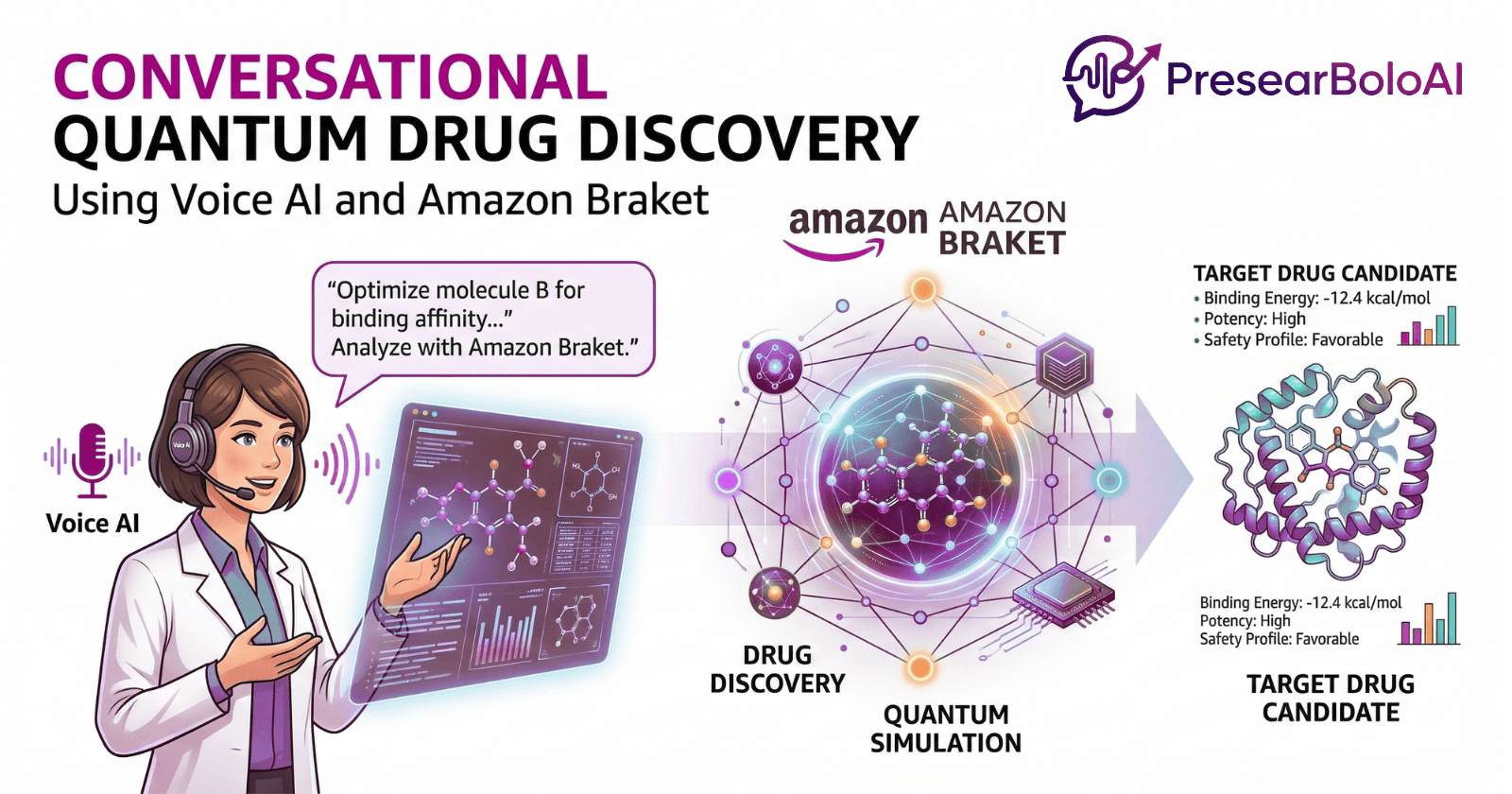
A Hybrid Architecture for Voice-Driven Molecular Simulation and Quantum Chemistry Experiments
How PresearVisionXTrans™ Can Secure Large Gatherings like Holi
How Presear Engineered a Burst-Resilient Government Recruitment Portal using AI-Ready Scalable Architecture
Enterprise AI has entered a decisive phase. For years, organisations treated AI as an exploratory tool. It was used in isolated pilots, innovation labs, or small automation projects. In 2025 and 2026, this behaviour is shifting. AI is becoming an operational layer that touches decision making, process execution, and knowledge flow inside large enterprises.
Three movements define this shift.
Modern AI systems can read documents, understand tables, interpret images, follow conversations, extract meaning from audio, and analyse logs. Enterprises finally have a single system that understands information across formats. This resolves the biggest information problem organisations face: knowledge fragmentation.
Enterprise systems are beginning to work independently. These AI agents analyse a situation, choose the next step, call internal APIs, update records, prepare reports, and complete workflows. They do not behave like chatbots. They behave like digital workers that understand context and perform tasks with consistency.

Leadership teams want faster processes, lower operational load, and a reduction in human dependency for routine work. AI aligns perfectly with this expectation. It compresses cycle times, improves accuracy, and reduces the cost of handling large volumes of information.
This combination marks a strategic turning point. The competitive gap in the coming years will not be between companies that have AI and companies that do not. It will be between organisations that operationalise AI at scale and those that remain stuck in indefinite pilot mode.
Enterprises rarely struggle with starting an AI pilot. The challenge begins when they attempt to convert that pilot into a fully deployed system. Most initiatives stop at the proof of concept stage because the organisation discovers gaps that were invisible during experimentation.
Four structural reasons explain this failure.
Pilots work on curated samples. Production systems must handle messy, incomplete, inconsistent, and distributed data. Many enterprises still rely on fragmented storage, outdated records, manual data entry, and systems that cannot communicate with each other. An AI model cannot operate reliably when the underlying data environment is unstable.

A pilot runs inside a controlled sandbox. A production system must integrate with the organisation’s existing tools, authentication systems, security frameworks, APIs, and operational pipelines. When enterprises try to scale, they discover limitations in throughput, latency, storage, access control, or compute. These issues stall the rollout.
AI pilots are often initiated by innovation teams rather than the departments that actually own the process. As a result, the team running the pilot does not have budget control, accountability, or authority to enforce adoption. Without business ownership, even a successful pilot does not progress.
AI alters workflows, job roles, reporting structures, and decision cycles. Many enterprises underestimate the organisational shift required to move from manual processing to AI assisted or AI driven execution. Employees hesitate to trust or adopt systems that feel unfamiliar. This resistance often kills momentum after the pilot.
A pilot demonstrates potential. Production reshapes the organisation. The shift is not cosmetic. It alters how information flows, how teams coordinate, and how decisions are executed. Once AI becomes a living component inside enterprise systems, several transformations begin to occur simultaneously.

In a pilot, AI is touched by a limited group of people. In production, employees interact with it throughout the day. The system is no longer an experiment. It becomes part of routine work. Every query, every document, every instruction contributes to a growing operational memory. This constant feedback loop strengthens accuracy and stability.
Production AI does not wait for a user to ask a question. It monitors processes, identifies patterns, detects anomalies, and surfaces insights automatically. The organisation moves from a reactive posture to a proactive one. Leaders receive early warnings, trend signals, and context that inform strategic action.
A pilot focuses on a narrow slice of a process. A production system absorbs the entire workflow. It sees the entry point, the transition points, the bottlenecks, the exceptions, and the completion. Over time, the system learns where delays originate and which interventions improve throughput. This creates a feedback-driven optimisation loop that manual teams could never achieve at scale.
Once AI takes over repetitive tasks, employees spend more time on judgement heavy work. Analysts focus on interpretation instead of data gathering. Managers focus on decisions instead of document reviews. Operational teams focus on exceptions instead of routine transactions. Production AI redistributes effort across the organisation in a more efficient pattern.
One of the least discussed benefits of production AI is the creation of a unified knowledge layer. Documents, logs, emails, chats, forms, and historic records become accessible through a single intelligent interface. Knowledge that was previously locked inside departments or individual systems becomes searchable and usable across the enterprise.
In production, AI stops being a tool and becomes an operational engine. It rewires how work is done and how value is created. This is the moment where competitive advantage begins to compound.
Enterprises that intend to operate at scale with AI must treat it as a core capability, not an isolated technology project. The winners will be the organisations that design long term infrastructure, create disciplined governance, and embed AI into the fabric of everyday work.

AI only performs at production level when it can access accurate and comprehensive information. Enterprises need a unified layer that connects documents, databases, applications, communication logs, and operational records. This layer becomes the foundation for every intelligent system that follows.
A collection of disconnected AI tools does not create transformation. Enterprises need platforms that handle ingestion, retrieval, reasoning, workflow execution, monitoring, and feedback. This platform mindset ensures that each new use case builds on the strength of the previous one.
AI must be governed with the same seriousness as finance, compliance, or cybersecurity. Clear responsibilities, audit trails, approval structures, security permissions, privacy controls, and lifecycle management are essential. AI cannot scale inside a structure that does not trust or control it.
Employees are not replaced. They are repositioned. Organisations must train teams to work alongside AI systems and use them as decision partners. When employees understand how the system works and what value it offers, adoption becomes natural and voluntary.
The objective is not to deploy AI. The objective is to improve throughput, reduce friction, strengthen accuracy, and accelerate decisions. Enterprises that define measurable outcomes early see faster returns and clearer adoption paths.
These principles form a predictable pattern. Every organisation that aims to lead in the next decade will reach the same conclusion. AI is no longer a project. It is an operating model.
Production level AI creates a structural advantage that compounds with time. Enterprises that commit to this path now will define the competitive landscape of 2026 and beyond.