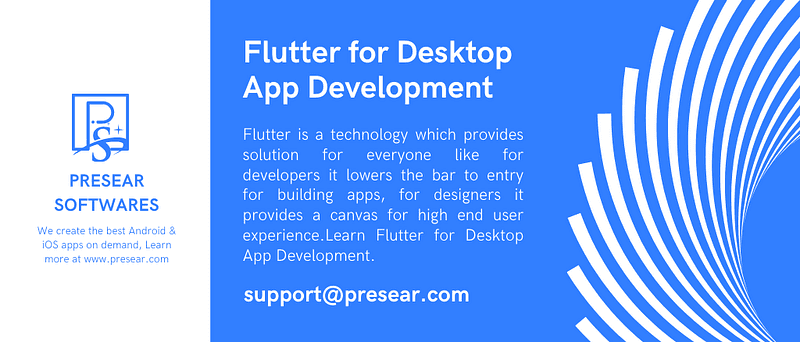
Flutter is a popular open-source mobile application development framework created by Google. However, it is not limited to mobile app development, as Flutter can also be used for desktop application development. According to a report by Grand View Research, the global desktop application market was valued at USD 17.3 billion in 2020 and is expected to grow at a CAGR of 7.6% from 2021 to 2028. This shows the potential of the desktop app development market. In this blog, we will discuss how Flutter can be used for desktop application development and the benefits it offers.
Flutter is a cross-platform framework, meaning that the same codebase can be used to develop applications for multiple platforms, including mobile, web, and desktop. Flutter’s desktop support is currently in beta and is available for Windows, macOS, and Linux. Developers can use Flutter to build native desktop applications that run on each platform’s native graphics and input APIs.
A question arises in mind if we have mobile apps and web apps then why do we actually need desktop apps? So here is the answer :
Desktop apps can offer several advantages over web-based or mobile apps, depending on the use case.
Here are some reasons why desktop apps might be necessary or preferred:
Offline Access:
Desktop apps can function even when the device is not connected to the internet, which can be essential in situations where internet access is limited or unreliable.
Better Performance:
Desktop apps can utilize the full processing power and memory of the device they are installed on, allowing for faster and more complex operations than web-based or mobile apps.
Enhanced Security:
Desktop apps can be more secure than web-based apps since they are installed locally on the device and can be protected with additional security measures.
Access to Local Resources:
Desktop apps can access local resources like the file system, printers, and cameras, which can be useful in applications like photo editing software or video conferencing.
Customization:
Desktop apps can be customized to meet specific user needs and preferences, which can enhance user experience and productivity.
Flutter for desktop development offers several benefits:
Hot Reload:
Hot Reload is one of the most popular features of Flutter. It allows developers to make changes to the code and see the changes in real time without having to rebuild the entire application. This feature speeds up the development process and helps developers to iterate quickly.
Native Look and Feel:
Flutter for desktop development provides a native look and feel for each platform. This means that applications built using Flutter will have a consistent appearance and behaviour across all platforms.
High Performance:
Flutter is built with performance in mind. The framework uses Dart programming language, which is optimized for client-side development. Flutter also provides a widget-based architecture that enables the framework to build and render complex user interfaces with high performance.
Easy to Learn:
Flutter is easy to learn for developers who are familiar with object-oriented programming languages like Java or C#. The framework provides extensive documentation and a large community that can help developers get started quickly.
Reusable Codebase:
As mentioned earlier, Flutter allows developers to write code once and use it across multiple platforms. This feature reduces the development time and cost, as developers do not need to write platform-specific code.
Growing Community:
Flutter’s popularity is growing rapidly, and the community is expanding quickly. Developers can find plenty of resources, tutorials, and packages to help them develop applications more efficiently.
The future of Flutter for desktop development looks promising, as Flutter has gained significant traction among developers due to its fast development time, hot-reload feature, and customizable UI components. Flutter’s support for desktop platforms is still in beta, but it has already been used to develop desktop applications for Windows, macOS, and Linux.
In addition to traditional desktop apps, there is also a growing market for cloud-based desktops, where users can access their desktop environment and apps from any device with an internet connection. This approach provides greater flexibility and accessibility for users and can help businesses reduce IT costs.
According to the 2021 State of Flutter survey conducted by Dashbird, a cloud monitoring platform, 30% of Flutter developers use Flutter for desktop development. Additionally, 45% of respondents reported that they were interested in using Flutter for desktop development in the future. The Flutter desktop support is still relatively new, and there are limited statistics available. However, in the same 2021 State of Flutter survey, 72% of respondents reported that they were satisfied with the Flutter desktop support, indicating that it is a promising area of development for the future.
Overall, Flutter’s desktop development support has gained significant interest among developers. The limited data conveys that it is still to be introduced to a larger group of people although the satisfaction rate is quite convincing which makes it a tool to try on.
Conclusion:
Flutter for desktop development is an excellent choice for developers who want to build cross-platform applications with a native look and feel. The framework provides several benefits, including hot reload, high performance, easy-to-learn, and reusable codebase. Flutter’s desktop support is still in beta, but it is rapidly improving, and developers can expect to see more features and improvements in the near future.
We have extensive experience in developing Flutter apps and have helped many businesses like yours to develop mobile apps that have boosted their customer engagement and sales. Our team can provide you with end-to-end services, including app development, design, testing, deployment, and maintenance.
We would love to discuss your requirements and how our team can help you develop the perfect mobile app for your business.
We have extensive experience in developing Flutter apps and have helped many businesses like yours to develop mobile apps that have boosted their customer engagement and sales. Our team can provide you with end-to-end services, including app development, design, testing, deployment, and maintenance.
We would love to discuss your requirements and how our team can help you develop the perfect mobile app for your business.
We have extensive experience in developing Flutter apps and have helped many businesses like yours to develop mobile apps that have boosted their customer engagement and sales. Our team can provide you with end-to-end services, including app development, design, testing, deployment, and maintenance.
We would love to discuss your requirements and how our team can help you develop the perfect mobile app for your business.
Email: support@presear.com
Whatsapp: 7008187611
Website: www.presear.com